


How to Learn Effectively with AI: A Guide for Students
For years, students have followed a familiar formula.
Go to college. Attend classes. Study the syllabus. Pass the exams. Complete a few certifications. Add everything to your resume.
Then apply for jobs.
But AI is changing this formula.
Today, a student can ask an AI tool to explain a difficult concept in seconds. AI can write code, summarise a book, analyse data, draft an email and even help complete assignments.
That sounds like a huge advantage.
And it is.
But it also creates a new problem.
If AI can help you produce an answer, how do you know whether you actually understand the problem?
This question may become increasingly important for students, job seekers and employers.
The World Economic Forum’s Future of Jobs Report 2025 identifies AI and big data, networks and cybersecurity, and technological literacy among the fastest-growing skills. At the same time, analytical thinking remains the most important core skill identified by employers.
That tells us something important.
The future is not simply about learning more tools.
It is about learning how to use technology while still being able to think, analyse and solve problems yourself.
AI Has Changed the Meaning of Being Job-Ready
Being job-ready once meant something relatively simple.
You had the required qualification.
You understood the basics of your subject.
You knew some relevant tools.
You could answer questions in an interview.
Today, that is often not enough.
Employers increasingly want people who can:
- Understand a problem.
- Find the right information.
- Use modern tools, including AI.
- Evaluate the output.
- Make decisions.
- Communicate clearly.
- Apply their knowledge in a real situation.
LinkedIn’s 2025 Work Change Report estimated that by 2030, 70% of the skills used in most jobs could change, with AI acting as a major driver of this change.
This does not mean that everything you learn today will become useless. It means that the ability to keep learning and adapting is becoming part of being employable.
At UPSPIR, we focus on helping learners build practical, job-ready skills that prepare them to contribute in real technical roles.
The Biggest Risk: Using AI Without Learning
AI can be a powerful teacher.
But it can also make it easier to create the illusion of learning.
Imagine a student learning Python.
Earlier, they might spend an hour trying to understand why their code was not working.
They would read documentation.
Search for answers.
Try different approaches.
Make mistakes.
Eventually, they would understand the problem.
Today, the student can simply paste the error into an AI tool and get corrected code within seconds.
The problem is not the AI tool.
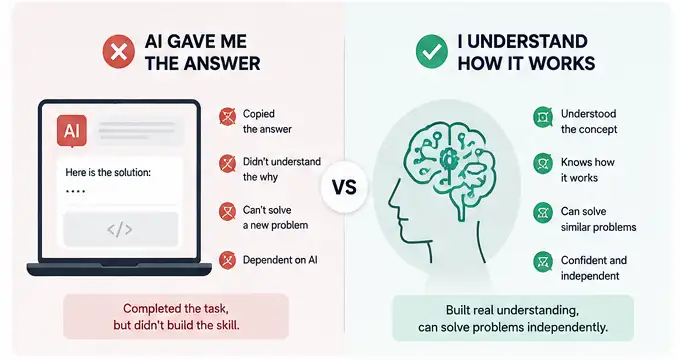
The problem comes when the student copies the answer, the program works, and they move on without understanding why it works.
They have completed the task.
But they may not have developed the skill.
This is the distinction students need to understand.
Getting the answer is not the same as learning how to find the answer.
In the workplace, the second skill matters.
AI will often help you.
But someone still needs to understand the situation, ask the right questions, check whether the answer makes sense and take responsibility for the final decision.
The New Learning Model: Learn, Apply, Use AI, Verify
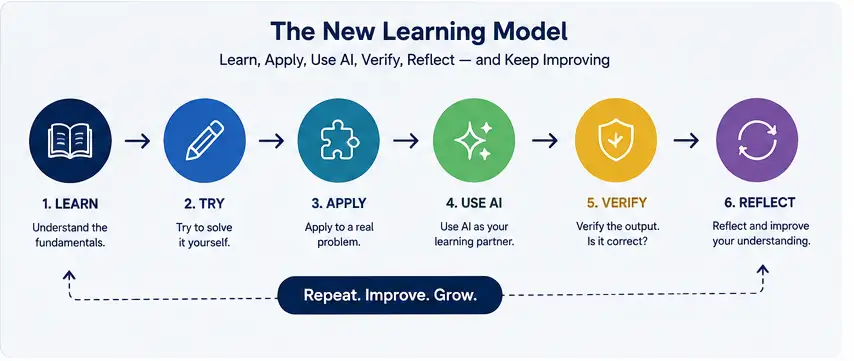
We believe students need a different approach to learning in the AI era.
Not:
Learn everything first → Use it later
But:
Learn → Try → Apply → Use AI → Verify → Reflect
Let’s look at what this means.
1. Learn the fundamentals
AI can help you work faster.
But it cannot replace the need to understand the basics of your field.
If you are learning technical support, you still need to understand:
- How Linux works.
- What happens when a network connection fails.
- How DNS works.
- How databases store and retrieve data.
- How to read logs.
- How to investigate an issue.
If you do not understand the fundamentals, you may not know whether the AI-generated answer is correct.
AI should build on your understanding.
It should not replace it.
2. Try to solve the problem yourself
Before asking AI for the answer, spend some time thinking.
What is the actual problem?
What information do you have?
What could be causing it?
What would you check first?
This does not mean you should avoid AI.
It means you should develop your own thinking before outsourcing the thinking.
Even a few minutes of independent problem-solving can make a big difference to how deeply you learn.
3. Use AI as a learning partner
This is where AI becomes extremely powerful.
Instead of asking:
“Give me the answer.”
Try asking:
“Help me understand how to approach this problem.”
Or:
“I think the issue could be caused by these three things. What am I missing?”
Or:
“Don’t give me the solution yet. Ask me questions that will help me find it.”
This changes AI from an answer machine into a learning partner.
The way you use AI matters.
Job-Ready Skills Are Becoming a Combination of Three Things
Students often ask:
What skills should I learn for the future?
There is no single list that will work for every career.But the strongest professionals are likely to combine three types of skills.

1. Domain skills
These are the skills required to do your job.
For example:
- Linux
- Networking
- SQL
- Cloud
- Data analysis
- Programming
The exact skills will depend on your career.
2. AI and technology skills
You do not necessarily need to become an AI engineer.
But you should understand how AI and modern tools are changing your work.
For example:
- How AI can support your daily work.
- How to give AI useful context.
- How to evaluate AI-generated output.
- When not to trust AI.
- How to use AI without compromising quality or security.
The World Economic Forum expects technological skills to grow faster in importance than any other major skill category, with AI and big data leading the list.
3. Human and problem-solving skills
This is where many students make a mistake.
They assume that as technology becomes more important, human skills become less important.
The evidence suggests the opposite.
Analytical thinking, resilience, flexibility, creative thinking and curiosity continue to be highly important as work changes.
In real jobs, someone still needs to:
- Understand the customer.
- Ask the right questions.
- Work with other people.
- Explain a complex issue clearly.
- Make decisions when information is incomplete.
- Take ownership when something goes wrong.
AI can support these activities.
But the professional using AI is still responsible for the outcome.
Stop Collecting Courses. Start Building Proof.
Another thing AI is changing is the value of simply saying:
“I know this.”
A resume can list twenty skills.
A LinkedIn profile can list fifty.
But employers increasingly need to know:
Can you actually use them?
This is why students should focus on building proof.
Instead of only completing a course on Linux, try solving Linux-related problems.
Instead of only learning SQL syntax, analyse a dataset and answer business questions.
Instead of only learning cloud concepts, work through a deployment or troubleshooting scenario.
Instead of simply saying that you know how to use AI, show how you used it to improve a piece of work—and explain what you verified yourself.
Your projects do not need to be huge.
What matters is that you can explain:
- What was the problem?
- What did you do?
- What tools did you use?
- How did AI help, if you used it?
- What challenges did you face?
- How did you verify the result?
- What did you learn?
That tells an employer much more than a certificate alone.
The Future of Learning May Look More Like Work
One of the biggest changes we expect is that good learning will increasingly look like the work people are preparing for.
For example, a technical support professional should not only study networking concepts.
They should receive a simulated customer issue.
They should investigate it.
Check logs.
Use available documentation.
Use AI when appropriate.
Communicate their findings.
Document the resolution.
This is much closer to what happens in a real job.
At UPSPIR, this is an area we are actively thinking about.
We believe AI should not simply be added as another topic in a course.
AI should influence how people learn, practise and demonstrate their skills.
That means moving beyond:
Watch → Learn → Take a quiz
Towards something closer to:
Understand → Practise → Face a problem → Investigate → Use tools → Get feedback → Improve
AI can make this process more personalised.
It can generate new scenarios.
Provide feedback.
Challenge a learner when they make assumptions.
And help them practise repeatedly.
But the learner still needs to do the thinking.
So, What Should Students Do Now?
You do not need to panic and try to learn every new AI tool.
Start with a simpler approach.
Choose a direction
Be clear about the kind of work you want to do.
Technical support, cloud, data, software development, marketing or another field.
A clear direction makes learning more useful.
Learn the fundamentals
Do not skip the basics because AI makes information easy to access.
Fundamentals help you understand and evaluate what AI gives you.
Build practical skills
Do projects.
Solve problems.
Work with realistic scenarios.
Make mistakes.
Fix them.
Learn to work with AI
Understand how AI can support your specific field.
Experiment with it.
But always ask:
Do I understand the answer, or did I simply receive it?
Build evidence of your skills
Keep your projects.
Document what you did.
Explain your decisions.
Show your learning process.
Keep learning
The goal is no longer to become “finished.”
The goal is to become someone who can continue learning as work changes.
The Question Is Not Whether AI Will Change Your Career
It already is.
The more useful question is:
What kind of professional will you become in a world where AI is available to everyone?
Knowing how to use AI will matter.
But that alone will not be enough.
The people who stand out will be able to combine AI with real knowledge, analytical thinking, practical skills and human judgment.
They will know when to trust AI.
When to question it.
And when to solve the problem themselves.
That is what being job-ready may increasingly mean in the age of AI.
At UPSPIR, we are exploring how AI can help people learn more effectively, practise in more realistic environments and get better feedback on their skills.
But our core belief remains simple:
AI should make people more capable—not make them dependent on answers they do not understand.
The future will not belong to people who know the most AI tools.
It will belong to people who know how to learn, think and use those tools to do better work.