

How AI Is Changing Cloud, DevOps and SRE Careers
AI is changing software development. But the change does not stop with developers. It is also changing how companies build, deploy, monitor and operate software.
Cloud engineers are using AI to understand infrastructure and troubleshoot problems faster. DevOps engineers are using AI to improve automation and deployment workflows. SREs are using AI to analyse incidents, identify patterns and reduce the time needed to restore services.
This does not mean that Cloud, DevOps or SRE careers are disappearing. It means the nature of the work is changing.
The engineers who once spent hours looking through logs, writing repetitive scripts or manually investigating alerts are increasingly working with intelligent tools that can perform parts of that work.
The valuable question is therefore no longer:
“Will AI replace Cloud, DevOps and SRE engineers?”
A better question is:
“What will these engineers be expected to do when AI handles more of the routine work?”
That is where the future of these careers becomes interesting.
AI Is Moving Cloud, DevOps and SRE From Execution to Engineering
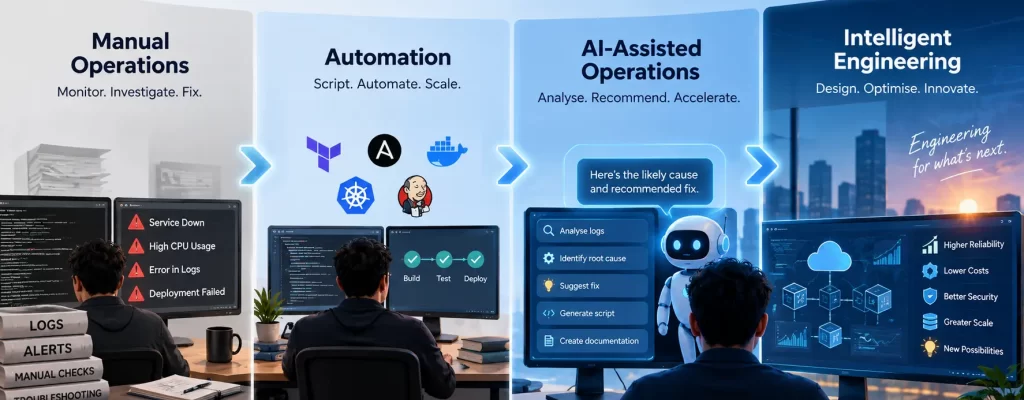
Traditionally, many infrastructure and operations tasks followed a familiar pattern.
- A system generated an alert.
- An engineer investigated it.
- The engineer checked logs.
- They identified the likely cause.
- They ran commands.
- They changed a configuration.
Then they monitored the system to make sure the problem was fixed. AI can now assist with several parts of this process.
Modern cloud and operations platforms can analyse large amounts of telemetry, identify unusual behaviour, summarise incidents and recommend possible actions. AWS, for example, is already developing agent-based capabilities that can investigate incidents across operational data and propose mitigation steps. This changes the engineer’s role.
Instead of spending most of the time finding information, engineers can spend more time understanding what the information means and deciding what should happen next. That is a significant career shift.
Cloud Engineers: From Managing Infrastructure to Designing Intelligent Infrastructure
Cloud engineering has already moved far beyond manually managing servers.
Infrastructure as Code, containers, managed cloud services and automation have reduced a large amount of repetitive infrastructure work.
AI is accelerating that change.
An AI assistant can help an engineer:
- Generate infrastructure configurations
- Explain cloud errors
- Analyse logs
- Identify unusual resource usage
- Suggest configuration changes
- Help troubleshoot networking problems
- Summarise monitoring data
- Identify potential cost issues
- Create documentation
- Explain unfamiliar infrastructure
But there is an important difference between generating a configuration and designing the right architecture.
An AI tool may suggest a solution.
The engineer still needs to ask:
- Is it secure?
- Will it scale?
- What will it cost?
- What happens when the system fails?
- Does it meet our availability requirements?
- What are the consequences of this architecture?
This is why cloud fundamentals remain important.
AI can generate Terraform.
It cannot remove the need to understand why the infrastructure should be designed in a particular way.
The cloud engineer of the future
The role is gradually moving toward:
Infrastructure management → Infrastructure engineering → Intelligent infrastructure
Engineers who understand cloud architecture, networking, security, automation and reliability — and know how to use AI effectively — will be better positioned than engineers who only know how to perform repetitive cloud tasks.
DevOps: From Automation to AI-Assisted Delivery
DevOps has always been about reducing friction between development and operations. CI/CD pipelines, Infrastructure as Code, automated testing and deployment automation have already transformed software delivery. AI is now becoming another layer in that workflow.
For example, AI can help engineers:
- Generate pipeline configurations
- Analyse failed builds
- Explain deployment errors
- Review infrastructure changes
- Suggest fixes
- Generate scripts
- Summarise pull requests
- Identify patterns across previous incidents
- Assist with release decisions
This means DevOps engineers may spend less time writing every piece of automation manually. But that creates a new responsibility. Someone has to understand whether the automation is correct.
- AI-generated infrastructure can be wrong.
- AI-generated scripts can introduce security problems.
- AI-generated changes can work in one environment and fail in another.
So the DevOps engineer’s value moves toward designing, validating and governing automation. The engineer becomes less of a person who simply builds pipelines and more of a person who builds systems that can safely build and deploy software.
SRE: From Responding to Incidents to Preventing Them
SRE has always focused on reliability. But much of traditional SRE work can be reactive.
- An alert arrives.
- An engineer investigates.
- The team identifies the root cause.
- The service is restored.
The team then works on preventing the problem from happening again. AI can help change this loop. By analysing logs, metrics, traces and historical incidents, AI-powered systems can help engineers identify patterns and potential problems earlier.
AWS describes generative AI use cases in operations that include incident management, root-cause analysis, predictive maintenance and capacity planning. This creates an important opportunity for SREs. The future SRE may spend less time asking:
“What just broke?” and more time asking: “Why could this break, and how do we design the system so that it recovers automatically?”
That is a higher-value engineering problem.
The Skills That Will Become More Valuable
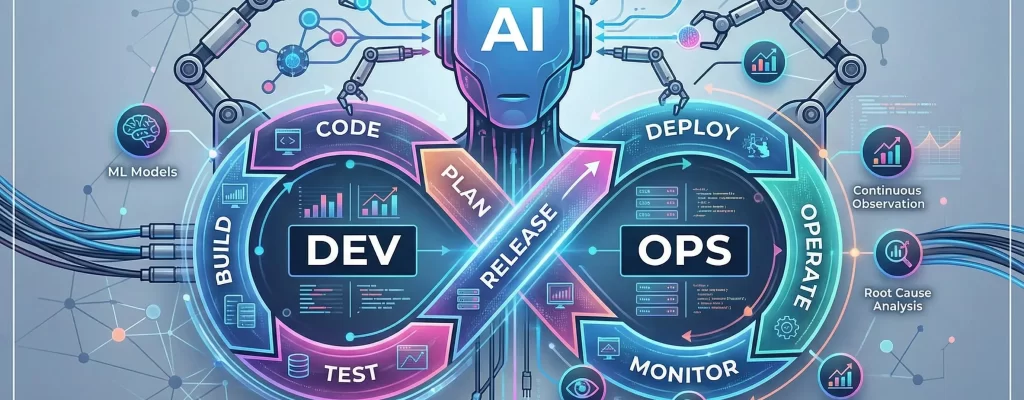
If AI is handling more routine work, what should Cloud, DevOps and SRE engineers learn? The answer is not simply “learn AI.” It is more specific.
1. Strong Cloud Fundamentals
Engineers need to understand how cloud systems actually work.
That includes:
- Compute
- Storage
- Networking
- Databases
- Identity and access management
- Security
- Scalability
- High availability
- Disaster recovery
AI can help you work faster. But it cannot replace understanding.
2. Automation and Infrastructure as Code
Automation remains fundamental. Engineers should become comfortable with technologies such as:
- Terraform
- Ansible
- Kubernetes
- Docker
- CI/CD
- Shell scripting
- Cloud automation
The difference is that AI will increasingly help engineers create and maintain automation. The skill is therefore moving from simply knowing syntax to understanding what should be automated and how to validate it.
3. Observability
AI needs data to reason about systems. That makes observability even more important. Cloud and SRE engineers should understand:
- Logs
- Metrics
- Traces
- Alerts
- Service-level objectives
- Error budgets
- Distributed system behaviour
The better the observability, the better an engineer — or an AI system — can understand what is happening.
4. AI Literacy
Cloud and DevOps engineers do not necessarily need to become machine learning researchers. But they should understand the basics of modern AI systems.
For example:
- What are large language models?
- How does inference work?
- What is an AI agent?
- What is RAG?
- What are model APIs?
- What makes AI workloads different from traditional applications?
- Why do AI workloads create different cost and performance challenges?
This knowledge helps infrastructure engineers work effectively with AI teams.
5. AI Infrastructure
This is where Cloud, DevOps and AI increasingly meet. AI workloads create new infrastructure requirements around:
- GPU computing
- Model serving
- Inference
- Data pipelines
- Scaling
- Performance
- Cost optimisation
- Security
- Observability
CNCF’s recent work on cloud-native AI highlights how Kubernetes and cloud-native infrastructure are increasingly being used to support AI workloads in production. This creates an interesting career direction:
Cloud + DevOps + AI infrastructure
You do not necessarily have to become an AI researcher. You can become the engineer who makes AI systems reliable enough to run in the real world.
What About Entry-Level Cloud and DevOps Jobs?
This is where the conversation becomes important for students and fresh graduates. Many entry-level candidates learn tools by following tutorials.
- They learn Linux.
- Then AWS.
- Then Docker.
- Then Kubernetes.
- Then Terraform.
- Then they add a certification.
But the AI era changes what job-ready means. Knowing a list of tools is not enough. Employers increasingly need people who can use those tools to solve problems.
The future entry-level engineer needs three layers of capability:
Layer 1: Fundamentals
Linux, networking, operating systems, databases and cloud concepts.
Layer 2: Engineering skills
Cloud, DevOps, automation, containers, CI/CD and monitoring.
Layer 3: AI-assisted engineering
Using AI to troubleshoot, automate, document, analyse and improve technical work.
This is a much stronger foundation than simply collecting certifications.
A Simple Roadmap for Cloud, DevOps and SRE Engineers
If you are already working in one of these areas, you do not need to throw away everything you have learned. Build on it.
Step 1: Strengthen your fundamentals
Understand Linux, networking, cloud architecture, security and distributed systems.
Step 2: Automate your existing work
Use Infrastructure as Code, scripting, CI/CD and containers.
Step 3: Start using AI every day
Use AI to:
- Explain errors
- Analyse logs
- Generate scripts
- Review configurations
- Create documentation
- Explore troubleshooting approaches
But verify the output.
Step 4: Build one AI-enabled infrastructure project
For example:
Deploy an AI application on the cloud and manage:
- Infrastructure
- CI/CD
- Monitoring
- Scaling
- Security
- Cost
You will learn much more from this than from simply watching another course.
Step 5: Learn the operational side of AI
Understand model serving, inference, AI workloads, observability and AI security at a practical level.
Step 6: Develop engineering judgment
This may become your most valuable skill.
Learn to ask:
- “Should we automate this?”
- “Is this safe?”
- “What happens when it fails?”
- “What will it cost at 10x scale?”
- “Can we trust the output?”
These are engineering questions. And AI makes good answers to these questions more valuable, not less.
The Future Is Not AI vs. Engineers
The debate around AI often becomes too simple.
- Will AI replace engineers?
- Will engineers who do not learn AI lose their jobs?
- Will everyone need to become an AI engineer?
The reality is more nuanced. AI is changing the task mix inside technical jobs. Routine work is becoming easier to automate. Information is becoming easier to access. Code is becoming easier to generate. Troubleshooting is becoming faster.
At the same time, architecture, security, reliability, system thinking and accountability remain critical. That means the role of the engineer is moving upward.
From:
Executing → Automating → Designing → Governing → Improving
This is not the end of Cloud, DevOps or SRE. It is the next version of these careers.
At UPSPIR, We Believe Job-Ready Means More Than Knowing Tools
The technology industry is changing quickly. That is why preparing someone for a technical career cannot be limited to teaching tools or helping them collect certificates.
A job-ready professional needs to understand technology, solve problems, work with modern tools and adapt as those tools change. AI is now becoming part of that journey.
At UPSPIR, our focus is on building practical technical capability — so that learners do not just know what a tool does, but understand how to use it to solve a real problem.
Because the goal is not to prepare professionals for today’s tools. The goal is to prepare them for the way technology work is changing.