

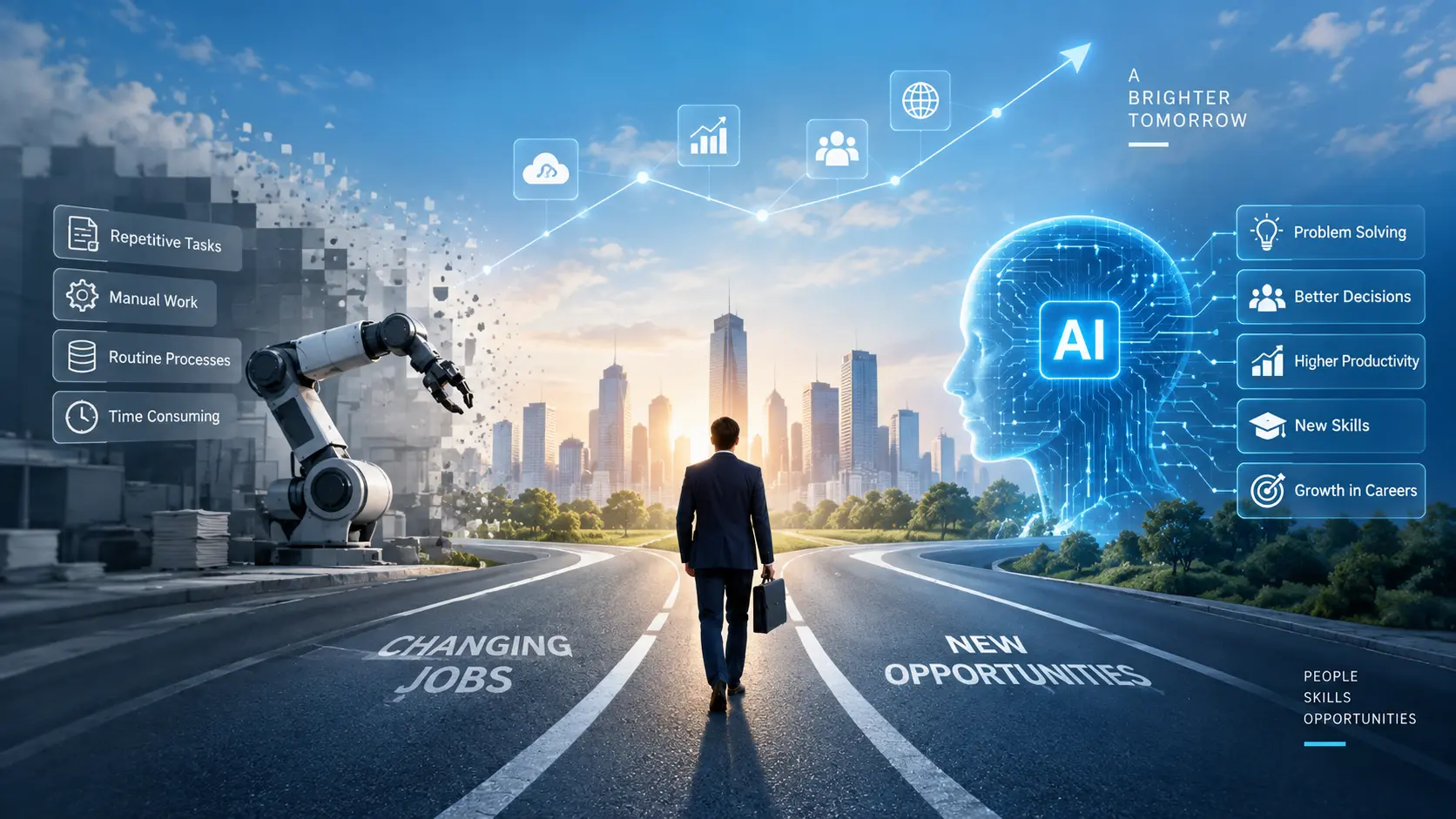
AI and Jobs: Why AI Will Reshape More Jobs Than It Replaces
Artificial intelligence is changing the way we work. That much is clear. But the conversation around AI and jobs often becomes too simple: AI will replace people. That is not the full story.
In many jobs, AI will not completely remove the role. Instead, it will change what people do, which tasks they spend time on, and what employers expect from them. A support engineer may spend less time searching through documentation and more time solving complex customer problems.
A software engineer may write less code manually and spend more time designing systems, reviewing AI-generated code, testing solutions and making technical decisions.
A data analyst may spend less time preparing data and more time interpreting results and helping a business make decisions. The job remains. The job changes. And this distinction matters enormously for students and young professionals preparing for their careers.
AI Will Change Tasks Before It Replaces Jobs
A job is usually not one single task. It is a collection of activities. Some of those activities are repetitive. Some require judgment. Some require communication. Some require technical knowledge. Some require understanding the business or customer. AI can automate some of these activities much more easily than others.
This is why looking at individual tasks gives us a better understanding of the impact of AI on jobs. Consider a technical support engineer.
A typical day may include:
- Reading customer problems
- Checking logs
- Searching documentation
- Reproducing issues
- Analysing errors
- Communicating with customers
- Escalating complex problems
- Documenting solutions
AI can increasingly help with several of these activities. It can summarise logs, search documentation, suggest possible causes, draft responses and help create troubleshooting steps. But that does not automatically mean the technical support engineer disappears. The engineer may instead spend more time on the difficult parts of the job:
Understanding the problem. Validating the diagnosis. Making decisions. Handling customers. Solving unfamiliar issues. The work changes. The value of the person changes. And the skills required change.
The Important Shift: From Doing Tasks to Managing Outcomes
This is one of the biggest changes AI is bringing to work. Traditionally, employees were often valued for how well they could perform a set of tasks. Increasingly, they will be valued for how well they can use technology to achieve an outcome. That is a very different skill.
Imagine two engineers. Engineer A can manually write code quickly.
Engineer B understands the problem, uses AI to generate possible solutions, evaluates those solutions, tests them, identifies errors, improves the implementation and understands how the solution fits into the larger system.
AI may make Engineer B significantly more productive. The advantage is no longer simply: “Who can write more code?” It becomes: “Who can solve the problem better?” This is why AI skills should not be viewed as a replacement for technical fundamentals. They should be viewed as an additional layer on top of them.
Some Jobs Will Be Rebalanced
Not every role will experience AI in the same way. For some jobs, AI will automate a large number of routine activities. For others, it will become a productivity tool that helps people perform their existing responsibilities better.
And some roles may grow because AI makes certain products and services cheaper, faster or more accessible. This creates an important relationship between automation and demand. Suppose AI makes it much cheaper to build software.
If businesses respond by building more software, creating more digital products and automating more business processes, the total amount of software work may increase even though each individual developer can produce more.
The same principle can apply in other industries. When technology reduces the cost of producing something, demand for that thing can sometimes grow. So productivity does not always mean fewer people. Sometimes it means more output, different roles and new opportunities.
Software Engineering Is a Good Example
Software engineering shows how quickly the nature of a job can change. AI coding tools can already generate code, explain code, suggest fixes and help developers work through problems. It would be easy to conclude:
If AI can write code, developers are no longer needed. But software engineering is much larger than writing code. Someone still needs to understand the problem. Someone needs to decide what should be built. Someone needs to think about architecture, security, reliability, performance and integration. Someone needs to validate whether the generated code actually works. Someone needs to understand what happens when the system fails. And someone needs to take responsibility for the final product.
As AI becomes better at producing code, these higher-level activities can become more important. This does not mean software engineering is completely protected from AI. It means the role is likely to evolve. The developer of the future may write less code manually but be expected to understand much more about the system being built.
Technical Careers Will Not Be Immune
The same pattern is visible across many technology roles.
Cloud and DevOps
AI can help automate infrastructure tasks, analyse logs, suggest configurations and identify possible failures. But someone still needs to understand the architecture, reliability requirements, security implications and business impact. The role can move from:
Managing individual infrastructure tasks
to:
Designing and managing reliable systems.
Technical Support
AI can answer common questions and automate repetitive troubleshooting. But complex incidents still require investigation, judgment and communication. The role can move from:
Finding standard answers
to:
Solving complex problems and managing customer outcomes.
Data and Analytics
AI can automate parts of data preparation, analysis and reporting. But organisations still need people who understand what the numbers mean and what decisions should be made from them.
The role can move from:
Producing reports
to:
Generating insights and supporting decisions.
Across these examples, the pattern is similar.
Routine work becomes easier to automate. Higher-value judgment becomes more important.
The Real Risk Is Not AI Alone
There is another important side to this discussion. The biggest risk for many workers may not be that AI directly replaces their job. It may be that their skills stop matching the job.
Imagine a company where every support engineer has access to AI tools. An engineer who knows how to use those tools effectively may be able to investigate problems much faster.
Another engineer may continue working exactly as before. Both technically have the same job title. But their productivity and value to the organisation can become very different. This creates a new form of career competition:
People will increasingly compete with other people who know how to work effectively with AI. That is why learning cannot stop when someone gets their first job.
What Skills Will Matter in the AI Era?
The answer is not simply:
“Learn AI.”
That is too vague. Professionals will need a combination of skills.
1. Strong fundamentals
AI can generate an answer. You still need to know whether the answer is correct. For a technical professional, fundamentals such as Linux, networking, databases, programming, cloud infrastructure and troubleshooting remain important.
In fact, stronger fundamentals can become more valuable because they help professionals evaluate AI-generated solutions.
2. AI literacy
Professionals need to understand how to use AI tools effectively.This includes knowing how to:
- Give useful instructions
- Provide the right context
- Evaluate AI output
- Identify errors and hallucinations
- Use AI for research and troubleshooting
- Combine AI with existing tools and workflows
3. Problem-solving
AI can generate possibilities. People still need to identify the right problem and decide which solution makes sense. Problem-solving becomes more important when technology can generate many possible answers very quickly.
4. Communication
Technology work does not happen in isolation.Engineers communicate with customers, managers, product teams and other engineers. As routine technical work becomes faster, the ability to explain problems clearly and work with people becomes even more valuable.
5. Judgment and ownership
Someone needs to decide:
- Is this solution safe?
- Is it correct?
- Will it work in production?
- What happens if it fails?
- AI can assist with these questions.
It cannot remove human accountability.
What Does This Mean for Students?
For students and fresh graduates, the message should not be:
AI is coming. You should be worried.
The better message is: The definition of being job-ready is changing.
Learning a technology from a course is no longer enough. A candidate needs to demonstrate that they can use their knowledge to solve practical problems.
For example, knowing Linux commands is useful. But being able to investigate a real system problem using Linux, understand what went wrong, use AI where appropriate, validate the suggested solution and explain the resolution is much more valuable.
Similarly, knowing cloud concepts is useful. Being able to troubleshoot a real cloud environment is different. Knowing programming syntax is useful. Being able to understand a business problem, design a solution and use AI to accelerate implementation is different.The gap between k nowing and doing is becoming even more important.
The Career Question Is Changing
For years, students have asked: Which technology should I learn to get a job? That question is still relevant. But it is no longer enough.
A better question is: What problems will I be able to solve, and how will AI change the way I solve them?
This is a much more useful way to think about career development. The future will not belong only to people who know AI.
It will belong to people who combine:
Technical knowledge + problem-solving + communication + AI capability + practical experience.
What Employers Will Look For
As AI becomes part of everyday work, employers are likely to care less about whether a candidate can perform every routine task manually. They will care more about whether the candidate can contribute to real outcomes.
For an entry-level technical professional, that could mean:
- Can you troubleshoot a real problem?
- Can you explain what you are doing?
- Can you work with technical tools?
- Can you use AI without blindly trusting it?
- Can you learn when the problem is unfamiliar?
- Can you communicate with a customer or teammate?
- Can you take ownership of a task?
- Can you validate your work?
These are not completely new skills. But AI is making them more important.
The Future Is Not Simply Human vs. AI
The conversation around AI and jobs is often framed as a competition:
Humans vs. AI.
That is probably the wrong frame. For most professionals, the more immediate competition will be:
- People who know how to work with AI vs. people who do not.
- AI will eliminate some tasks.
- It will change many jobs.
- It will create new kinds of work.
- And in some areas, it will reduce the number of people required to perform certain activities.
There is no reason to ignore those risks. But there is also no reason to assume that every technology job will disappear. The more useful response is to understand how work is changing and prepare accordingly.
Because the most important career skill in the AI era may not be mastering one particular tool.It may be the ability to keep becoming more valuable as the tools change. AI may change the job. Your responsibility is to keep growing with it.