

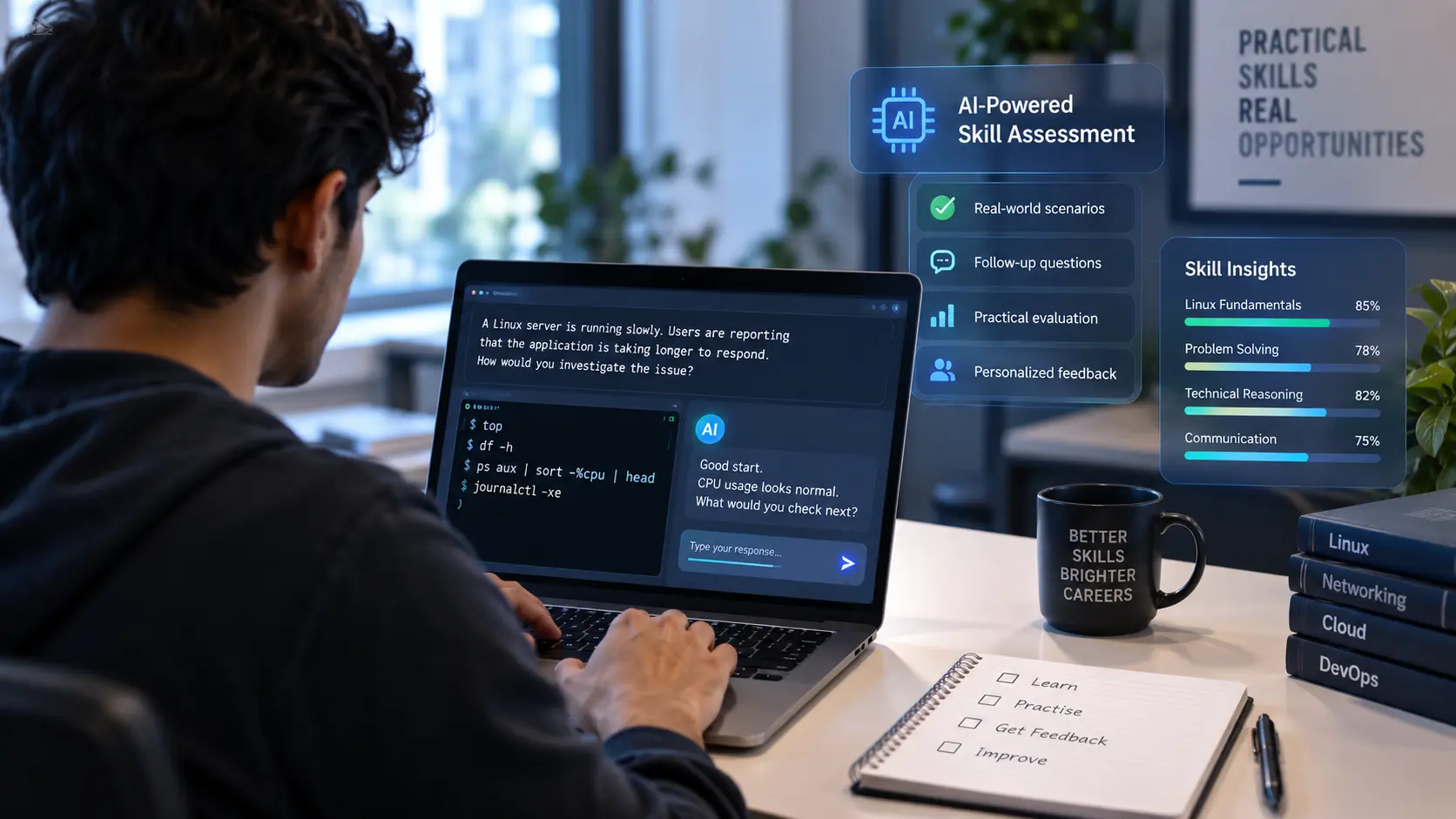
How UPSPIR Is Using AI to Rethink Skill Assessment
For a long time, skill assessment has been built around a simple question:
What does this candidate know?
Candidates answer multiple-choice questions, complete coding tests, solve predefined problems or attend interviews. These methods have their place, but they do not always tell us what we really want to know:
Can this person actually use what they know?
This question becomes even more important as AI changes the way people learn and work.
The World Economic Forum’s Future of Jobs Report 2025 says analytical thinking remains one of the most important core skills for employers, while AI and big data are among the fastest-growing skills. The report also highlights the growing importance of technological literacy, creative thinking and problem-solving.
LinkedIn’s skills data also shows that the skills used at work are changing rapidly, with AI literacy becoming increasingly important. Its 2025 India list highlighted skills such as creativity and innovation, problem-solving, code review and strategic thinking among the fastest-growing skills.
This creates a new challenge. If the skills employers need are changing, shouldn’t the way we assess those skills change too? At UPSPIR, this is one of the questions we are exploring. We are using AI to rethink what a skill assessment should actually measure.
The problem with traditional skill assessment
Traditional assessments are often designed to make evaluation easy to administer and easy to score. That makes sense. A multiple-choice test can assess hundreds of candidates quickly. A coding platform can automatically evaluate a program. An interview can help assess communication and problem-solving. But each method has limitations.
A candidate might know the correct answer without knowing how to apply it. Someone might perform well in a test but struggle when faced with an unfamiliar production problem.
Another candidate might understand the fundamentals but perform poorly because they are not comfortable with the format of the test. And for technical roles, knowing a concept is only one part of being job-ready.
Consider a technical support engineer. Knowing what DNS is matters. But real work might require the person to:
- understand a customer’s problem
- identify the relevant symptoms
- check DNS configuration
- analyse logs
- use command-line tools
- form a hypothesis
- test it
- communicate the findings
- document the solution
A traditional question such as “What is DNS?” checks knowledge. A real troubleshooting scenario checks something much closer to job performance. That difference matters.
From testing knowledge to evaluating skills
This is where our thinking around AI skill assessment begins. We believe assessment should move closer to the actual work a person is expected to perform.
Instead of asking only: Do you know this?
we want assessment to explore questions such as:
- Can you apply it?
- How do you approach an unfamiliar problem?
- What steps do you take?
- Can you explain why you chose that approach?
- Can you identify what went wrong?
- Can you improve your solution?
This is a different philosophy of assessment. It moves from answer checking toward skill evaluation and AI gives us new possibilities for doing this at scale.
We are exploring a more conversational assessment model
One area we are working on at UPSPIR is using AI to make assessments more interactive. Instead of presenting only a fixed list of questions, an AI-based assessment can use a candidate’s response to determine where the conversation should go next.
For example:
Question:
You receive an API error from a customer’s application. How would you troubleshoot it?
Candidate:
I would first check the API response and status code.
AI follow-up:
You receive a 401 response. What would you check next?
Candidate:
I would verify the authentication token.
AI follow-up:
The token appears valid. What else could cause the issue?
- The goal is not to create a difficult conversation.
- The goal is to understand depth of knowledge and problem-solving ability.
- A candidate who genuinely understands the topic should be able to reason through the situation.
- A candidate who has only memorised definitions may struggle when the situation changes. That distinction is valuable.
Practical evaluation is a key part of the model
AI alone does not make an assessment practical. The assessment design matters just as much. At UPSPIR, we are therefore looking at a combination of AI evaluation and practical exercises.
For example, a candidate learning technical support might work through scenarios involving:
- Linux
- SQL
- networking
- APIs
- browser troubleshooting
- cloud fundamentals
- customer issues
The candidate needs to do something, not just select an answer. That could mean writing a command, analysing an output, troubleshooting an issue, explaining a decision or working through a scenario. The system can then evaluate the work against predefined expectations.
This brings us closer to a simple principle: Don’t only test what someone remembers. Test what they can do with what they know.
AI can make assessment more adaptive
Another important advantage is adaptability. A traditional assessment generally gives every candidate the same questions. AI can make the assessment more responsive.
If a candidate demonstrates strong knowledge in one area, the system can explore a deeper problem. If the candidate struggles with a fundamental concept, the assessment can investigate that area further. This creates the possibility of an assessment that is less like a fixed questionnaire and more like a structured technical conversation.
For example:
- Candidate demonstrates strong Linux fundamentals → move toward troubleshooting.
- Candidate struggles with networking fundamentals → explore the underlying concepts.
- Candidate solves the problem but cannot explain the reasoning → ask follow-up questions.
The objective is not simply to make the assessment harder. It is to make the assessment more informative.
Final thought
The real promise of AI in skill assessment is not automation for the sake of automation. It is the possibility of understanding a candidate better.
A score can tell us where someone stands on a test. A well-designed practical assessment can tell us much more about how they think, how they work and where they need to improve.
That is the direction we are exploring at UPSPIR. Because in an AI-driven world, the question should not simply be: What do you know?
It should increasingly be: What can you do with what you know?